Elevating User Experience: Mastering Streaming and Suspense in Next.js
Elevating User Experience: Mastering Streaming and Suspense in Next.js
The Modern Web's Performance Challenge
In today's fast-paced digital world, user expectations for web application performance are higher than ever. Traditional rendering approaches, whether full server-side rendering (SSR) or client-side rendering (CSR), often present a dilemma: either users wait for a complete page load, experiencing a blank screen, or they interact with an incomplete page while data trickles in.
This fundamental challenge remains: how do we deliver complex, data-rich applications without making users wait? To solve this, developers are moving beyond traditional methods and mastering Next.js rendering techniques like SSR, SSG, and ISR for peak performance.
Introducing Streaming: Delivering Content Incrementally
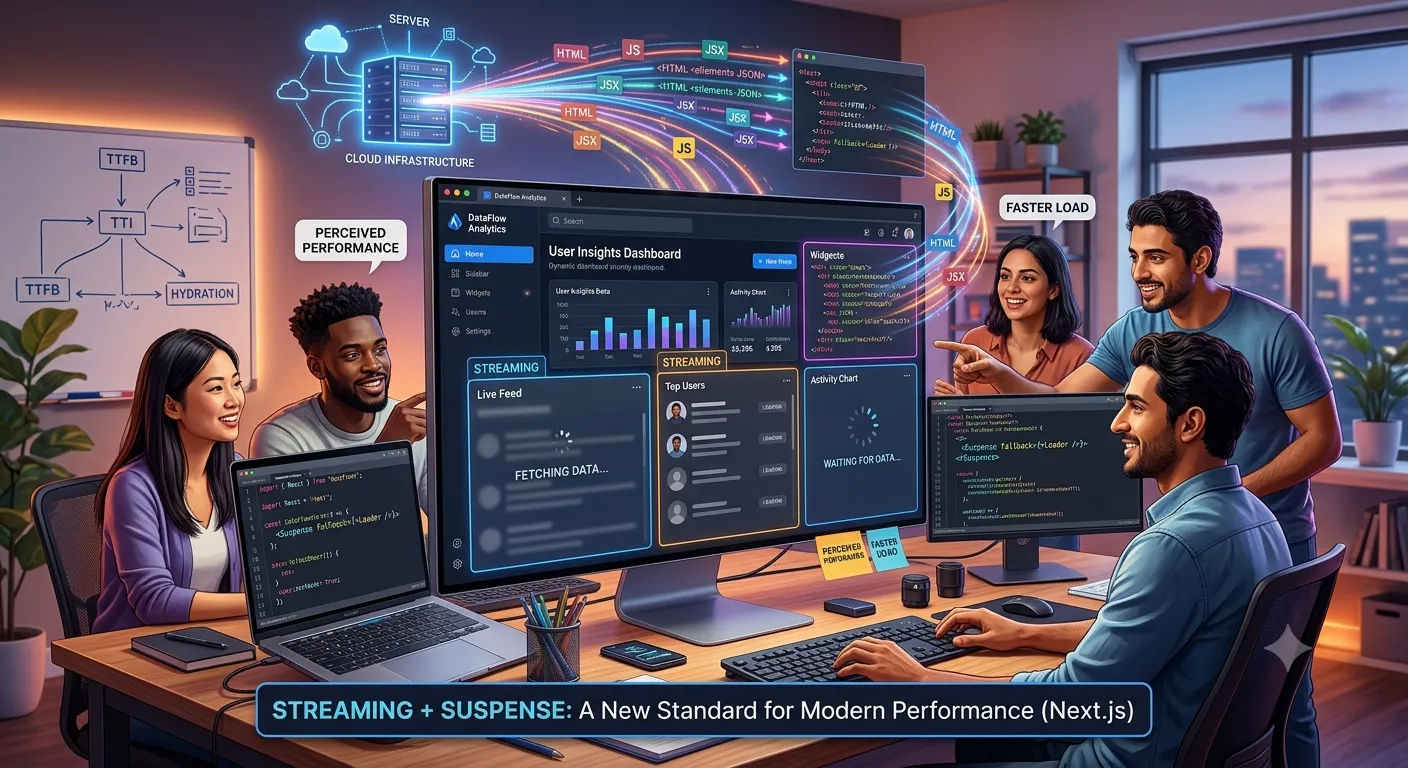
Next.js introduces streaming as a game-changer. Streaming allows your server to send parts of your HTML to the browser as soon as they're ready, instead of waiting for the entire page to be rendered. This means the user sees meaningful content much sooner, improving the Time To First Byte (TTFB).
This capability is deeply tied to the advancements in Next.js Server Components. By rendering components on the server and streaming their HTML, Next.js ensures that your application's shell appears almost instantly. For a deeper understanding of how this fits into the bigger picture, you can explore the power of Next.js Server Components in modern development.
Suspense: Orchestrating Loading States Gracefully
While streaming handles the server-side delivery, React Suspense takes over on the client-side, elegantly managing the loading states of individual components. Suspense allows you to wrap parts of your UI that depend on asynchronous data with a fallback (e.g., a skeleton screen).
This approach prevents disruptive layout shifts and provides immediate visual feedback. When combined with efficient data fetching and caching strategies in the App Router, Suspense ensures that your application remains responsive even when dealing with complex asynchronous operations.
The Synergy: Streaming + Suspense for Superior UX
The true power lies in the synergy between streaming and Suspense. Next.js streams the initial HTML shell, and as the data for specific components becomes available, it streams the completed HTML for those parts.