The Attention Goldmine: Why Tech is Leaving the Web for Mobile Apps
The Attention Goldmine: Why Tech is Leaving the Web for Mobile Apps (And the Psychology Behind It)
We were all caught up in a massive illusion. For the past few years, every tech guru, major brand, and full-stack developer was shouting from the rooftops: "Make your web application so incredibly fast and powerful that users never have to download an app again." We poured our lives into mastering server components, edge functions, and ultra-optimized browser speeds. We genuinely believed we were making the user's life easier.
But right now, in the middle of 2026, a strange and completely opposite wave is taking over the tech world.
Global brands, streaming platforms, and even mid-sized e-commerce stores are quietly pushing their users back toward native iOS and Android apps. They are intentionally limiting features on their web layouts and displaying persistent pop-ups at every turn: "For the best experience, download our mobile app."
This isn't driven by a technical limitation. Browsers today are more capable than they have ever been in software history. So, why is this reverse migration happening? The answer isn't hidden inside lines of digital code; it lies deep within the human brain—a brain that has become deeply exhausted, distracted, and overwhelmed by digital noise.
1. The Browser Tab Graveyard: Where Brands Go to Die
When was the last time you opened a mobile browser and looked at just one single, isolated tab? Probably never.
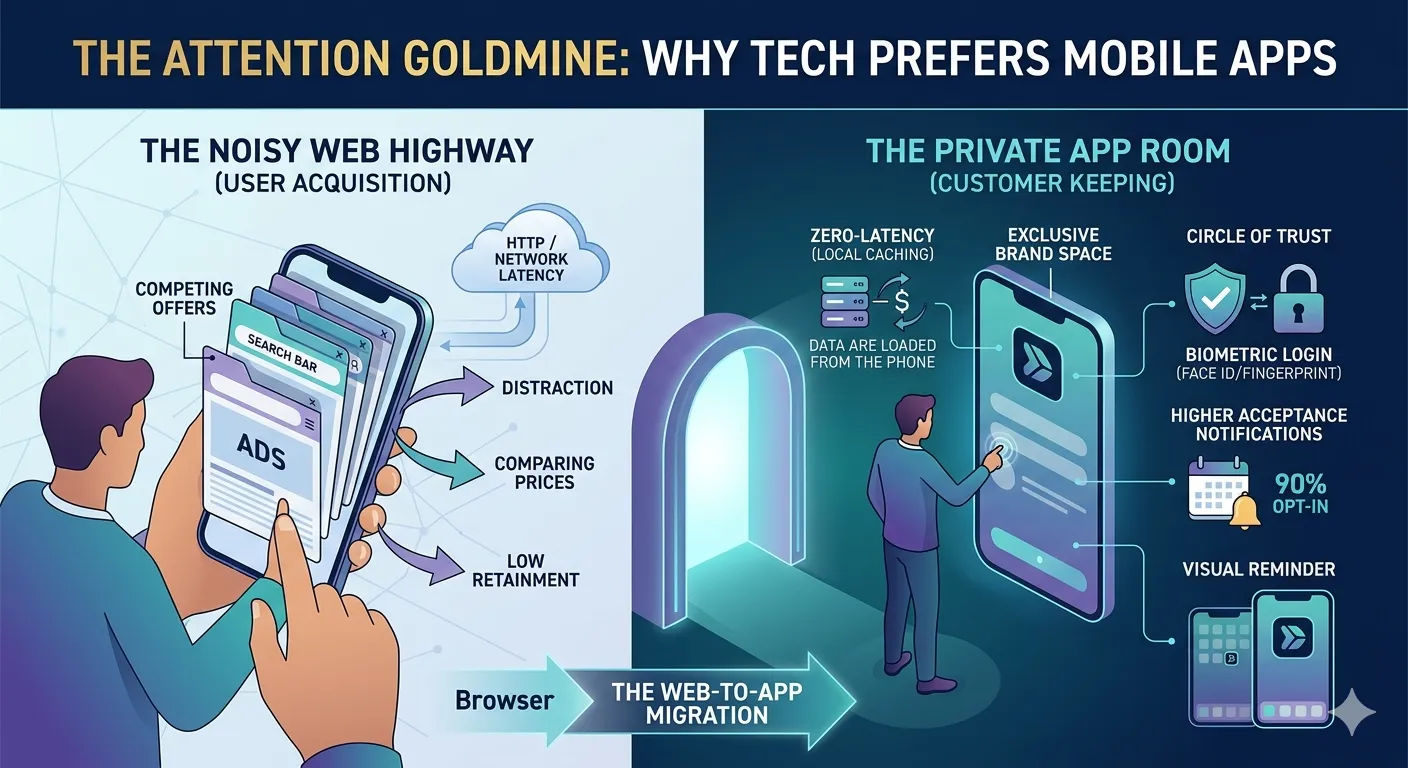
The psychology of the modern consumer is chaotic. When an average user opens a browser on their phone, they are instantly greeted by a messy stack of twenty forgotten tabs. They might be looking at a product on your carefully optimized website, but a sudden glance at an old background tab triggers a thought, they click away, and your lead is gone forever. The browser is a noisy public highway full of flashing billboard signs. Keeping a user focused there is like trying to hold water in your hands.
Businesses have realized that trying to retain a customer inside a standard browser tab is a losing battle.
A mobile app, however, acts as a private room. The moment a user clicks your app icon, they completely disconnect from the open web. There are no competing tabs, no universal Google search bars begging them to go compare prices elsewhere, and no third-party banner ads. It offers a level of absolute focus and psychological control that brands are willing to spend millions to secure.
2. Notification Fatigue and the "Circle of Trust"
When web push notifications first became widely supported, marketing departments celebrated. But human behavior adapted instantly: we learned to aggressively block them. Today, whenever a website loads and asks, "Can we send you notifications?" our thumbs automatically hit 'Block' without a second thought. We do not trust browsers enough to let them into our personal daily space.
The psychological relationship a human has with a native mobile app is fundamentally different. Downloading an app is a conscious investment—a silent agreement that says, "I actually care about this platform, and I am choosing to grant it a piece of my digital real estate."