The Rise of On-Device AI: Why Small Businesses Are Bringing Intelligence In-House
The Rise of On-Device AI: Why Small Businesses Are Bringing Intelligence In-House
Artificial intelligence has moved beyond the realm of science fiction and into the everyday operations of businesses worldwide. For a long time, deploying powerful AI meant relying heavily on vast cloud infrastructure, sending your data off to distant servers for processing. While cloud AI offers immense scalability and access to cutting-edge models, a quiet revolution is underway, particularly among small and medium-sized businesses (SMBs): the shift towards on-device AI.
This isn't just a technical curiosity; it's a strategic move driven by evolving data privacy concerns, the demand for real-time responsiveness, and a keen eye on operational costs. For many SMBs, the idea of keeping intelligence local, right where the data is generated, offers compelling advantages that cloud-only solutions simply can't match. It’s about empowering your business with smart tech without necessarily sending all your sensitive information on a round trip to the internet.
What Exactly is On-Device AI?
Put simply, on-device AI refers to artificial intelligence models that run directly on a local device—be it a smartphone, a smart camera, an industrial sensor, or even a local server within your business premises—rather than exclusively relying on cloud servers for computation. This means the AI processes data and makes decisions right at the "edge" of the network, close to the source of information.
Think about it: instead of a security camera sending every frame to the cloud for facial recognition, an on-device AI camera can identify a known employee locally and only send an alert if an unfamiliar face appears. Or, imagine a retail point-of-sale system that uses AI to recommend products based on local inventory and customer purchase history, without needing constant cloud interaction.
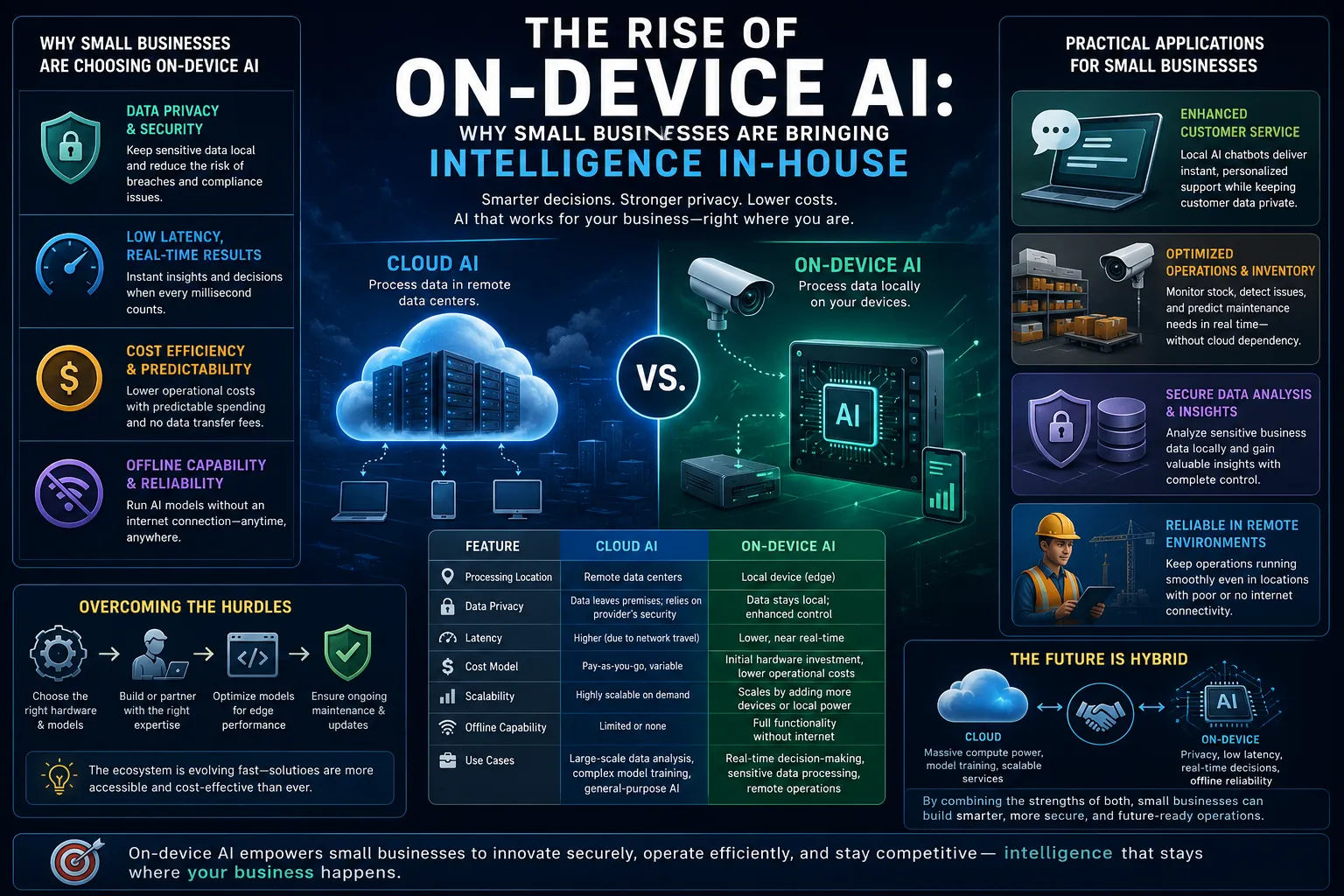
This approach stands in contrast to traditional cloud AI, where data is transmitted to remote data centers, processed by powerful servers, and then the results are sent back to the device. Both have their place, but understanding the distinction is crucial for strategic deployment.
Why Now? The Driving Forces Behind On-Device AI Adoption
The move towards local AI isn't random; it's a response to several critical business needs and technological advancements. Here's why small businesses are increasingly considering bringing intelligence in-house:
Data Privacy and Security are Paramount
In an era of heightened awareness around data breaches and stringent regulations like GDPR and CCPA, keeping sensitive information local is a massive advantage. When AI processing happens on-device, proprietary business data, customer details, or even employee performance metrics don't need to leave your secure environment. This significantly reduces the risk of data exposure during transit or storage on third-party servers.
For small businesses, trust is a cornerstone of client relationships. Demonstrating a commitment to data privacy by processing information locally can be a strong differentiator. It aligns perfectly with the principles of AI governance and ethical AI, ensuring your use of technology respects user privacy from the ground up.
Latency and Real-time Operations Demand Speed
Some business operations simply cannot afford delays. Imagine a manufacturing plant using AI for real-time quality control on an assembly line. Sending images to the cloud, processing them, and waiting for a response introduces latency that can lead to costly errors or slowdowns. On-device AI eliminates this round trip, enabling instantaneous decision-making.
For customer service applications, like an intelligent chatbot assisting with immediate queries, low latency translates directly to a smoother, more satisfying user experience. In sectors like healthcare or emergency services, real-time processing can literally save lives.
Cost Efficiency and Predictability
Cloud AI services often operate on a pay-as-you-go model, which can lead to unpredictable and escalating costs, especially as usage grows. Data transfer fees, API calls, and processing power can quickly add up. For small businesses with tighter budgets, these variable costs can be a significant concern.
While on-device AI might require an initial investment in hardware, the operational costs for processing are often lower and more predictable in the long run. Once the hardware is in place and the models are optimized, you have more control over your expenditure, avoiding the surprise bills that sometimes come with extensive cloud usage.
Offline Capabilities and Reliability
Not every business operates in an area with robust, always-on internet connectivity. Construction sites, remote agricultural operations, mobile service providers, or even businesses in areas prone to internet outages can benefit immensely from AI that functions independently of a constant cloud connection. On-device AI ensures that critical operations continue uninterrupted, maintaining productivity and reliability even when the internet goes down.
Cloud vs. On-Device AI: A Quick Comparison
To help you decide which approach, or combination, is best for your business, here's a brief comparison:
| Feature | Cloud AI | On-Device AI |
|---|---|---|
| Processing Location | Remote data centers | Local device (edge) |
| Data Privacy | Data leaves premises; relies on provider's security | Data stays local; enhanced control |
| Latency | Higher (due to network travel) | Lower, near real-time |
| Cost Model | Pay-as-you-go, variable | Initial hardware investment, lower operational costs |
| Scalability | Highly scalable on demand | Scales by adding more devices or local processing power |
| Offline Capability | Limited or none | Full functionality without internet |
| Use Cases | Large-scale data analysis, complex model training, general-purpose AI | Real-time decision-making, sensitive data processing, remote operations |
Practical Applications for Small Businesses
So, how can on-device AI practically benefit your small business?
Enhanced Customer Service
Imagine a smart chatbot running on your local server, trained specifically on your company's knowledge base and customer interactions. It can provide instant, personalized support without sending customer queries to an external cloud service. This not only speeds up response times but also ensures sensitive customer information remains within your control. This aligns perfectly with the goals of AI for hyper-personalization, but with an added layer of privacy.
Optimized Operations and Inventory
Small businesses in retail, manufacturing, or logistics can deploy on-device AI for tasks like inventory management. Smart cameras with local AI can monitor shelf stock, identify misplaced items, or even flag potential theft, all without streaming constant video feeds to the cloud. In manufacturing, edge AI can perform predictive maintenance on machinery, analyzing sensor data locally to anticipate failures before they happen, minimizing downtime and costs. This kind of intelligence helps democratize growth and efficiency for small businesses.
Secure Data Analysis and Insights
For businesses handling confidential client data, financial records, or proprietary research, on-device AI allows for powerful analytics without compromising security. You can gain valuable insights into trends, customer behavior, or operational bottlenecks by processing data locally, ensuring compliance with data residency requirements and maintaining a competitive edge.
Overcoming the Hurdles: Implementing On-Device AI
While the benefits are clear, implementing on-device AI isn't without its challenges. Initial setup can require more technical expertise than simply subscribing to a cloud service. You might need to invest in specialized hardware (like devices with dedicated AI accelerators or powerful local servers) and ensure your team has the skills to manage and maintain these systems.
However, the ecosystem for on-device AI is rapidly maturing. Many vendors are offering plug-and-play solutions, and the cost of powerful edge hardware is decreasing. Partnering with technology providers who specialize in local AI deployment can help small businesses navigate these complexities and unlock the full potential of this technology without needing an in-house team of AI experts.
The Future is Hybrid: Blending Cloud and On-Device
For most small businesses, the optimal solution won't be an either/or choice but a strategic blend of both cloud and on-device AI. The cloud remains invaluable for tasks requiring massive computational power, large-scale model training, or accessing diverse, general-purpose AI services. On-device AI will excel where privacy, low latency, cost predictability, and offline capability are paramount.
By intelligently distributing AI workloads, businesses can leverage the strengths of both approaches. Sensitive data processing stays local, while less critical or computationally intensive tasks can be offloaded to the cloud. This hybrid model offers the best of both worlds, providing flexibility, security, and efficiency.
Conclusion
The shift towards on-device AI represents a significant evolution in how small businesses can harness the power of artificial intelligence. It's a move driven by practical needs: the imperative for stronger data privacy, the demand for immediate responsiveness, and the desire for more predictable operational costs. As technology continues to advance, the ability to bring intelligence closer to the source of data will become an increasingly vital component of a resilient, efficient, and secure business strategy. For any small business looking to gain a competitive edge while safeguarding its most valuable assets, exploring the potential of on-device AI is no longer an option—it's a necessity.